
The Eagles, Krauss, Astatke, Regaled; 900 Grads Celebrated
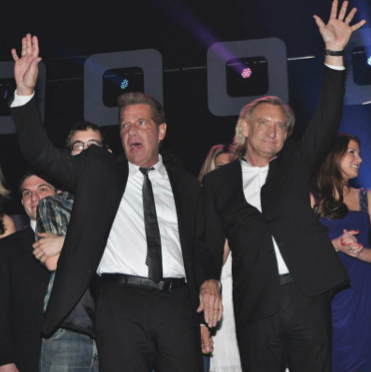
Glenn Frey (left) and Joe Walsh of the Eagles congratulate the student performers after the commencement tribute concert.
Phil Farnsworth
The ambitious May 11 show traversed a range of musical territory. Things kicked off with the sights and sounds of Berklee’s 10-member African Drum Ensemble. The colorfully costumed group (with members hailing from such locations as Australia, West Africa, Texas, and Vermont) danced and sang to the accompaniment of hand percussion. Their traditional song served as a bridge to “Derashe,” a composition by honoree Astatke. Born in Ethiopia, he was Berklee’s first African student in 1959. A vibraphonist and composer, he is credited with creating “Ethio-Jazz,” a blend of musical elements from African, Latin, and American jazz styles. “Derashe” was built on a pentatonic melody that was fleshed out with a large ensemble comprising horns and strings and included piano, flute, and alto saxophone solos. It was the first of three songs penned by Astatke. On the third, “Yèkèrmo Sèw,” Astatke joined the students onstage to play vibes. Astatke’s solo probed the harmonic confines of his minor key-tune. Also soloing were trumpeter Jenn Allen and saxophonist Grace Kelly.
The tribute to 27-time Grammy-winning singer and bluegrass fiddler Alison Krauss began with her hit “When You Say Nothing at All,” which received a heartfelt rendition from vocalist Naomi Gillies. A medley of Krauss’s duets included the bluesy “What the Cowgirls Do,” the country ballad “Whiskey Lullaby,” and the early rock number “Gone, Gone, Gone.” All were given first-rate treatments by Naomi Gillies and Dustin Hyatt (“Cowgirls”), Jennifer Waris and Torrence Nelson (“Whiskey”), and Melissa Wright and Will Makar (“Gone”). “Every Time You Say Goodbye” featured Sierra Hull on mandolin and vocals.

Multi–Grammy Award winner Alison Krauss sang with members of the Berklee Gospel Ensemble.
Krauss came onstage to sing a second traditional tune, “Down to the River to Pray,” which was featured in the movie O Brother, Where Art Thou? Associate Professor Dennis Montgomery III and the Berklee Gospel Ensemble provided reverential a cappella backing for Krauss. Together, they had the whole audience feeling a bit of religion by the song’s end.

From the left: Joe Walsh, Timothy B. Schmit, Mulatu Astatke, President Roger Brown, Alison Krauss, Don Henley, and Glenn Frey
The next morning, the students and honorees filed into the Agganis Arena clad in ceremonial caps and gowns. President Roger Brown introduced the Eagles, Krauss, and Astatke, and made the doctoral degree presentations. After the members of the Eagles received their honorary degrees, group spokesman Don Henley mentioned the student performance the night before. “Sometimes I worry about the future of music and culture,” Henley said. “But after what we all witnessed here last night, I have renewed hope and faith in the future of music. It was truly inspiring.”

Astatke to grads: "May your journey be blessed."
Phil Farnsworth