
Rethink Music 2.0

The indie band band Mayer Hawthorne performed at the evening showcases during the April "Rethink Music" Conference.
“We’re in the era of no excuses,” Berklee College of Music President Roger Brown noted as he addressed a ballroom full of music industry executives, artists, and students. He described how in the old days if something went wrong, a record label was easily blamed. A label with too much creative control or a shifting marketing staff could ruin a record and stall an artist’s career. Now, however, in the era of do-it-yourself marketing, if fans do not watch an artist’s videos or attend his or her shows, no one is responsible but the artist. “Don’t blame the man,” President Brown encouraged. “Be the man.”
These opening remarks set the tone for the April “Rethink Music” conference, presented by Berklee and MIDEM. In its second year, the event drew about 500 attendees to discussions on how to adapt and stay at the forefront of an ever-shifting industry. There were notable new offerings this year, such as the evening showcases by top indie acts, Hackers’ Weekend for music app developers, and the Music Deconstruction Experience for creative tools that artists can apply to musicians’ writing and recording process.
Tribal Communication
In the inspiring keynote speech “Making Something Happen,” renowned author Seth Godin noted the shift in the role of music, from a scarce commodity with gatekeepers to an abun- dantly available resource through the infinite choices of the Internet. “There’s no more notion of picking the next great act,” Godin emphasized. “Now it’s the era of cheap connection.”
The digital age certainly makes the world seem smaller, but success in music does not stem from an artist’s attempt to dominate all of the earth’s population. Rather, an artist needs to recognize his or her niche audience and lead them. Godin refers to this important concept as “tribe management.”
Video content has become a crucial means of managing these tribes, especially via YouTube. At the conference, viral YouTube sensation and musical group Karmin discussed how they exploited the intersection of music and video content as an integral part of establishing their career. “One of the best things for us was not being signed to a label at first,” says Nick Noonan, one-half of the duo. “It forced us to figure things out for ourselves and build our career on our own.”
Before signing to Epic Records, Karmin undertook building a base of hundreds of millions of YouTube views and hundreds of thousands of subscribers. Nils Gums, the group’s manager, used that foundation as leverage to maintain creative control in Karmin’s videos and music once their record deal was inked.
From the consumer’s perspective, the pairing of music and technology has increased the ease of discovering and sharing new music. Jim Lucchese, the CEO of the music- intelligence platform The Echo Nest, led a presentation that discussed “social playlisting.” The Echo Nest powers a mobile app called AudioVroom, which detects all the app users in a room, finds shared artists and song preferences that suit everyone, and generates a playlist based on that information. Such innovations as these are driving the increasingly social experience of music.
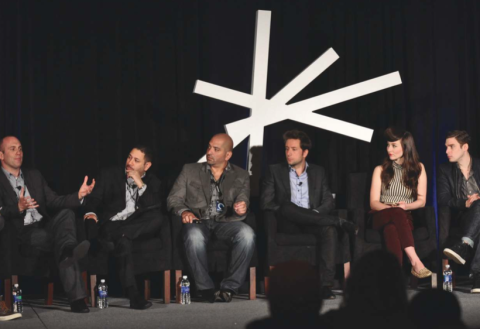
A panel discussion titled "The Intersection of Content: Music + Video" featured (from the left) Rio Caraeff of Vevo, Robert Fernandez and Junior Goris of Pitbull, and team Karmin: Nils Gums ’06 (manager), Amy Heidemann ’08 (vocalist) and Nick Noonan ’08 (keyboardist and singer).
Palmer admits that although actively maintaining her Twitter account is important for her career, she wondered how many more songs she could write if she spent more time solely creating music. “If you wake up in the morning and check your phone or your Twitter or your e-mail, something is wrong. You’re too connected. Be a human being first.”
Len Schlesinger, the president of Babson College, gave a lecture on entrepreneurship, stressing the importance for rising industry leaders and artists to take on an entrepreneurial mind-set. “Everyone is an entrepreneur,” Schlesinger noted. “Not everyone practices it.”
With new business models constantly emerging, industry personnel and musicians must be willing to fail, to learn from their mistakes, and to continue to push forward. Schlesinger shared the anecdote of Starbucks CEO Howard Schultz and how he created the company. After a trip to Italy, Schultz opened a café called Il Giornale in Seattle. He played opera music all day, there were no seats, and the entire menu was in Italian. It took more than 1,600 angry paying customers for Schultz to realize his mistakes. He used the lessons learned to create the success that Starbucks has become today.
Building a Brand
An artist’s external image and branding are just as important as his or her internal entrepreneurial drive. Rob Stone of Cornerstone and Geoff Cottrill of Converse both participated in a panel discussion on building an artist’s brand. The two collaborated in creating Converse “Rubber Tracks,” a studio in Brooklyn that enables emerging artists to record music for free and keep creative rights. The studio effec- tively boosts the artist’s awareness while empowering the Converse brand. “The definition of record labels needs to change, because artist needs have changed,” Stone advised. Cottrill agreed, adding, “I don’t think brands should be in the business of running a record label, but we can certainly help artists along the way.”
Despite the array of technological advancements, live engagements are still the driving force behind sustaining an artist’s career. During the presentation “The Future of Live Music,” David “Boche” Viecelli, the founder of the Billions Corporation, argued that live performances are the only way an artist can remain memorable and meaningful. Echoing President Brown’s remarks, Viecelli concurred that artists must take responsibility, and live shows are a crucial area where an artist has total control. “The future of live music is the future of music, period,” Viecelli asserted.
Rethink Music held a music industry start-up competition, called the Genesis Project, which accepted business proposals on how to effectively rethink music. The winning submission, “Have You Heard?,” leverages information from music-streaming services like Spotify to make sharing and listening to music more rewarding for fans and more lucrative for artists. The idea uses gaming elements with incentives such as discounted music and backstage passes for increased sharing and interaction with the artist. As the winning proposal, “Have You Heard?” was awarded $10,000 in legal and consultation services, as well as meetings with venture capi- talists to help give the innovative means of rethinking the industry a forward momentum.
Nick Susi earned his degree in music business and management and collaborated with President Roger Brown on the Music-Maker Case Study Series.