
Redefining the Album

Berklee Professor Stephen Webber
Past and Present
During the 1980s, as compact discs displaced vinyl records, consumers enjoyed improvements in portability, durability, and ostensibly sound quality, but at the cost of many fringe benefits of LPs. Smaller packaging meant there was less room for attention-grabbing cover art, information about the musicians, and liner notes.
Scott Snibbe, the lead developer on Björk’s 2011 release Biophilia, says, “A generation ago, when we bought an album, we would often choose it literally by its cover, then come home and be captive to it. Sitting on the floor and poring over the art, the lyrics, and other things that came with it helped us fall in love with the record over a period of time. The digital download effectively killed the album, and now we’re living in the ‘casual hook-up’ phase of music. That doesn’t mean that it isn’t a positive experience, but it’s shallower.”
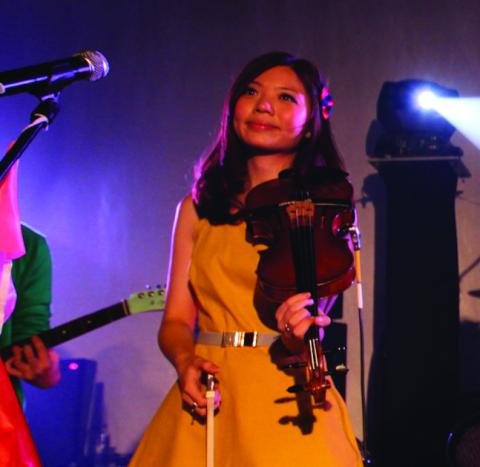
Musician and actress Winnie Lau of Modern Children
Webber foresees video becoming an integral part of recorded music in the near future. “In five years, people will rarely set up a microphone in the studio without also setting up a video camera,” he says. Indeed, some artists are already doing just that. Esperanza Spalding ’05 has just released her critically acclaimed project Radio Music Society, which includes a DVD with short films for every song. Webber adopted the same practice during production of his latest work, The Stylus Symphony, a first-of-its-kind symphonic piece that spotlights Webber as the featured soloist playing LP turntables. Looking forward, he sees opportunities for technological advances to support this sort of recording. “This could change the way we capture performances,” Webber says. “Right now Pro Tools is king, but the next big DAW [digital audio workstation] will probably have a way to simultaneously capture and edit both audio and video in a multi-track environment.”
Hong Kong–based indie-rock band Modern Children has expanded on this idea. They have incorporated audio and video into an iPhone- and Android-compatible app that also gives users access to a colorful calliope on which the listener can play along with the recordings.
“Having an app has given us a closer interaction with our fans,” says Modern Children singer and actress Winnie Lau, “and it’s increased our audience. We’re getting people from Norway, Saudi Arabia, New Zealand, and the United States downloading our songs.”

Max Weisel developed apps for Björk’s Biophilia album.
The addition of interactive elements challenges the notion of music as something that listeners receive passively. “[Interactivity] actually gets closer to music’s roots, rather than farther from them,” Snibbe says. “After all, before recordings, sheet music was the canonical form of a song, and users would change it in all kinds of ways, playing it with a different feel or tempo, sometimes even changing the words to the song. Music was something we engaged with.”
Snibbe and a confederation of other developers took this interactivity to new heights on Biophilia. “I wrote apps that would play the music,” says wunderkind developer Max Weisel, but that “would have instruments built into them that users could play. These apps can send to a MIDI output so people can use those instruments to perform their own music.”
This interactivity runs through all aspects of the Biophilia project, including the live tour. “I’m actually part of the band,” Weisel says. “I play the iPads on stage. Sometimes they function as pitched bass drums, and sometimes I can use them to modify what other musicians are doing. When [percussionist] Manu Delago uses effects pedals on his ‘hang’ [a pitched steel-drum-like hand percussion instrument whose name is pronounced “hong”], I can adjust all the parameters of those effects in real time. The audience hears the resulting sounds even before we do. At other times, I can remix the band before it gets to the front-of-house engineer, so these apps are really an integral part of the performance.”
Snibbe notes that the critical reaction to Biophilia has been enthusiastic. “The critics have really responded to this,” he says. “A number of reviewers said they hadn’t felt this fully engaged with an album in 20 years.”
One artist who has taken the concept of listener interaction even further is Washington, D.C.-based electro-pop outfit Bluebrain. The group’s app The National Mall is touted as the “first location-aware album” and mixes different samples for the listener as he or she moves through the National Mall. Band member Ryan Holladay explains how the group harnessed the technology of video games to create the work. “We used a video-game engine that makes sounds fade in and out as a character moves closer or farther from game assets,” Holladay says. “We replaced game sounds with musical motifs, and replaced game locations with real-world coordinates using the iPhone’s built-in GPS information. It’s not that revolutionary technologically speaking, but now we have the ability to do it in the real world, so we made an artistic, musical mapping rather than one which is based on game objectives.”

High levels of user input raise questions about artistic authenticity such as these: How much of the work is the artist’s? How much is the listener’s? Who is really in control? “That’s the challenge,” Holladay says. “When The Washington Post reviewed The National Mall, there was a route that I really wanted them to take because I knew it would sound good. But that would have gone against the point of the experience. A music reviewer can say they’ve listened to the new Katy Perry CD because they’ve heard it from the first track to the last, but nobody’s heard The National Mall in its entirety, and no one experience is more valid than another. We’re challenging how people consume music, and challenging ourselves as artists by forfeiting certain elements of control. I don’t even know that I’m fully comfortable with that yet myself.”
This explosion of additional content—videos, interactive instruments, games, text—has obvious implications for production budgets. While major studios may be able to accommodate those costs, they can present significant challenges to independent artists.
“The brother of one of our band members is a developer,” Lau says. “So we partnered with him. We own the rights to the music, but he owns the code.” Bluebrain adopted a similar model.
“When major studios do this,” Webber says, “they’re likely to pay developers on a work-for-hire basis. But independent artists will probably have to find other arrangements.”
That’s not to say that established artists won’t also team up with computer programmers. “All of the developers on Biophilia worked for equity,” Snibbe says. “So we enjoy a share in the profits. Actually, I would counsel everyone to work this way. You get a much better product when everyone has a stake in it.”
Webber suspects that this model could have far-reaching cultural implications. “This could change our concept of what it means to be ‘in a band,’” he says. “The term band could come to mean something more like an artistic consortium, sort of like a theater company. Some members might write songs or sing or play instruments, some create video content, and still others program computers.”
Of course, all these developments will necessitate changes in the way music is paid for and licensed. Artists like Björk are changing the artistic model, moving from albums to apps, but following a familiar business model in which the listener pays for the product. Biophilia is priced at $12.99, though users can purchase the individual song apps for $2.99 apiece. Artists such as Modern Children are offering their songs for free in the app, while Adele’s app only previews the song for users and provides a link to purchase the full track.
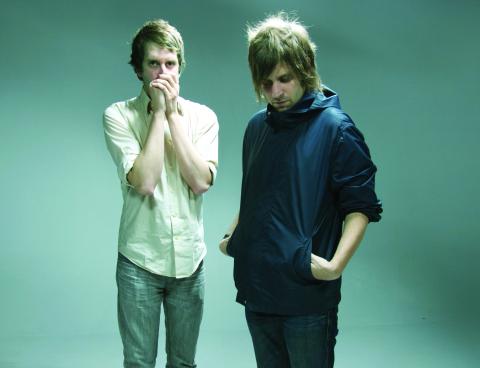
Hays and Ryan Holladay of Bluebrain create location-aware music.
For all the predictions, these artists and many more are experimenting to find what works for them. The next decade in the music industry is likely to be exciting, unpredictable, and above all, interactive.