
Jewels from the Mediterranean
I grew up in Huelva, Spain, in the southern part of the country, where flamenco music has its roots and is a big part of the culture. I was surrounded by flamenco from my childhood and it is more than just a style of music to me.
The origins of flamenco are ancient. Traditional music from the countries lining the shores of the Mediterranean Sea—Spain, Turkey, Israel, Italy, Greece, and the Balkan and North African countries—is musically rich and dates back thousands of years. The casteñuelas, or castanets, so prominent in flamenco music have been found in the pyramids of Egypt.
As a child, I’d studied oboe at a local conservatory and learned about the music of Schoenberg, Stravinsky, Brahms, and Mahler. But attending high school far from my home in Queens, New York, I realized that flamenco was the music I should focus on. When I returned to Spain, my mother told me I had to take a “serious” subject at college. So I began studying agricultural engineering at Universidad Politécnica de Madrid, but I knew I was going to be a musician, not an engineer. Not long after that, I wrote some flamenco songs that became successful in Spain. In 1997, my song “Mey Voy Contigo,” featuring singer Remedios Amaya and legendary guitarist Vincente Amigo, became the best-selling flamenco record ever. That’s when my mother realized that I wasn’t wasting my time with this music!
My songs earned me enough money to open my own recording studio, and I began producing records. By now, I’ve produced around 80 albums and have earned seven Latin Grammy Awards. Producing records for major labels such as EMI, Universal Music Spain, Sony Music, and my own Casa Limón label, has given me opportunities to work with many amazing musicians from the Mediterranean area.
In recent years, I’ve had many discussions about Berklee with President Roger Brown and Vice President for Academic Affairs/International Programs Larry Monroe. We spoke about the college’s reputation being built on its development of an approach to teaching jazz and popular American music styles, and now, technology. Roger, Larry, and I talked about Mediterranean music styles needing to be codified in a similar fashion so they could start being taught as jazz was first taught at Berklee. No one has done this for flamenco, Portuguese fado, or the music of Greece. Turkish music, for example, has thousands of styles, but there has never been a single place in the world where someone could study the differences and similarities in those styles—until now.
With the launch of the Mediterranean Music Institute in September 2011, Berklee began creating an archive of recordings and sheet music, producing a music festival, and starting a small record company devoted to exploring Mediterranean styles. The institute will give students exposure to the huge universe of Mediterranean music.
Currently I’m teaching courses in flamenco performance and record production, directing a flamenco vocal ensemble, and codirecting the Mediterranean Music Ensemble with Christiane Karam. I’m also working with Matthew Nicholl, the chair of the Contemporary Writing and Production Department, to develop online courses and a book on flamenco music.
Berklee’s campuses in Boston and Valencia are the two legs of the institute. The educational efforts at the Boston campus are known worldwide. In Valencia we have access to a lot of musicians with much to share with our students. That campus will become the door to Eastern and Western Europe as well as the Arab, Asian, and Latin American nations.
We hope future graduates of the program will take the flavors of traditional music or ethnic instruments and use them in their original music. One Berklee student in Valencia was pursuing jazz, but then discovered music from Sicily, where she comes from originally. She began singing Sicilian music and is going to make an album of songs by Rosa Balistreri, a Sicilian master singer. Through her studies in the institute, she has found a direction for her career.
There are many musical jewels from the countries around the Mediterranean just waiting to be discovered by musicians from the rest of the world.
.
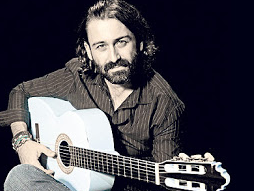
Javier Limon
Javier Limon