
Chasing Lassie and Gunsmoke

In February The Simpsons aired its 500th episode, making it the third-longest-running scripted prime-time show in TV history— just behind Lassie and Gunsmoke. The show’s longtime composer, Alf Clausen ’66, has recorded more than 15,000 cues during the show’s 22-year run with one of the most elite studio orchestras in television.
Many of the musicians Clausen uses have worked with him for more than 25 years. “They feel like family, and they love coming to work,” he says. “They play better in a comfortable situation, and I can take more risks musically with players that I know so well.”
Clausen draws on the depth of his musical background to cover the variety of styles needed to underscore The Simpsons. “My first gig was at age five, when I sang Norwegian folksongs with my mother playing piano for a local homemakers club,” he says.
“I began playing French horn in seventh grade and continued with that through high school, where I was also very involved in the choir. I took up acoustic bass in college and that led to my love of big-band music. During my days at Berklee,I gigged as a bass player and also did symphonic and concert band gigs on French horn. I continued all this when I first moved to Los
Angeles. With all this experience, handling a wide range of styles comes easy to me.”
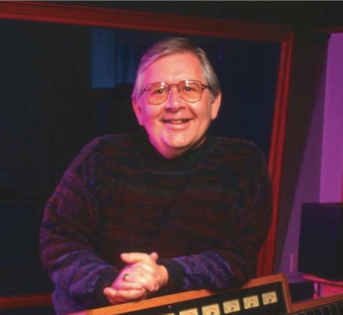
Alf Clausen
The Simpsons as well as the score. “I got lots of experience writing songs for musicals as a member of the BMI Lehman Engel Musical Theater Workshop for two years,” he says. “It seems ironic that the 30 Emmy nominations I’ve received and the two Emmy awards that I’ve won have all been in the Best Song category.” In fact, those 30 nominations give Clausen the highest number of nominations of any musician in the history of the Academy of Television Arts & Sciences music branch.
Scoring The Simpsons has yielded lessons about writing under the gun and supporting humor onscreen with music. “Someone once advised me that you can’t ‘vaudeville’ vaudeville,” Clausen says. “If you have a funny scene, it’s always more effective to write the music straight.” Regarding the pressure of writing to the show’s tight schedule, Clausen muses, “My experience with variety show choreographers back in the ’70s while writing for the Donny & Marie Show taught me to be quick on my feet and adaptable to change. Desperation is the mother of invention!”